
September 30 marks the National Day for Truth and Reconciliation. It is a day to honour Survivors of residential schools, remember the children who never returned home, and recognize the lasting impacts of the residential schools system on Indigenous families and communities. It is also a day that asks each of us to reflect on our own responsibility to reconciliation.
At Sea Change CoLab, much of our work centres on equity, inclusion, accessibility, and creating conditions where people can participate and belong. That work requires us to centre the experiences of people who have been excluded by systems and institutions. Truth and Reconciliation must be part of that ongoing work.
It requires learning the truth about Canada’s history and residential schools. It means listening to Indigenous voices and recognizing the knowledge and contributions of First Nations, Inuit, and Métis Peoples across Turtle Island. September 30 is an important reminder that reconciliation cannot be something we acknowledge once a year and then set aside.
This Truth and Reconciliation Day snuck up on us. In a busy workplace, it’s easy to get caught up in projects, deadlines, meetings, and the work right in front of us. And, in being truthful, we are writing this blog thinking about how wrapped up we get in our own day-to-day lives that we neglect the ongoing work of Truth and Reconciliation that we are all supposed to be doing. One resource that is helping us turn our reflections into ongoing action comes from the National Centre for Truth and Reconciliation website.
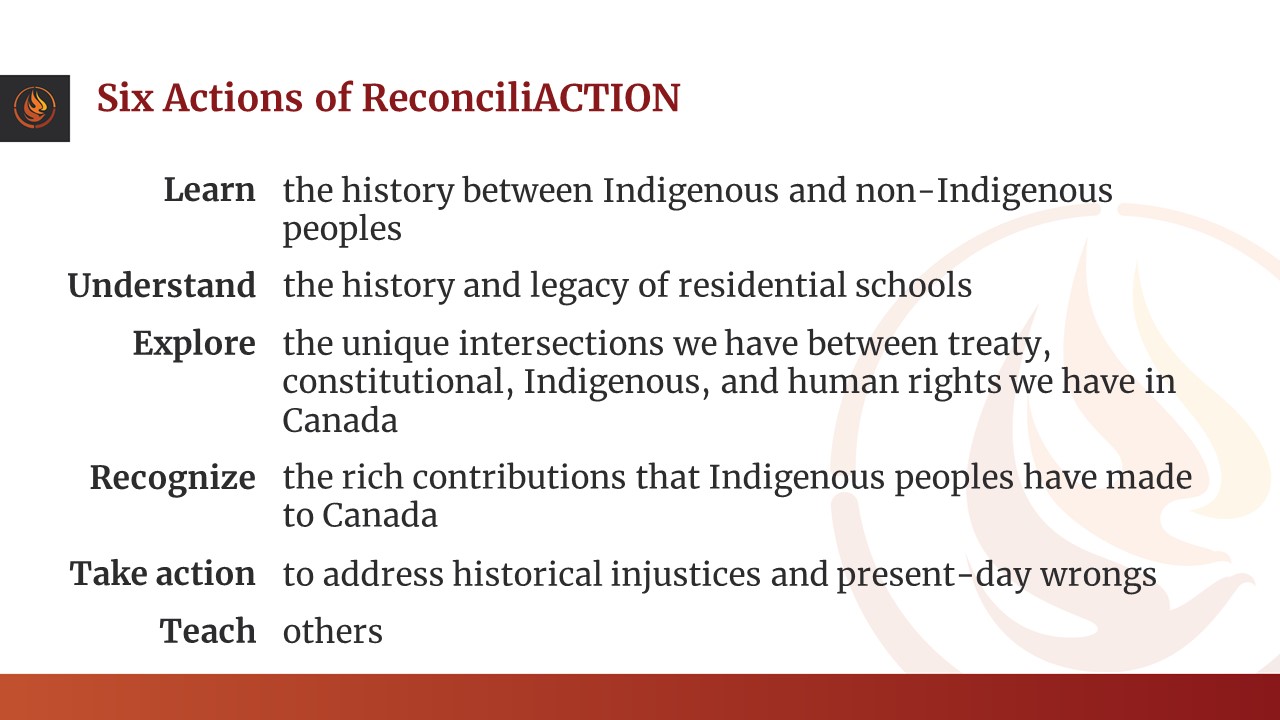
They outline six Actions of ReconciliACTION:
- Learn the history between Indigenous and non-Indigenous peoples.
- Understand the history and legacy of residential schools.
- Explore the unique intersections we have between treaty, constitutional, Indigenous, and human rights we have in Canada.
- Recognize the rich contributions that Indigenous people have made in Canada
- Take action to address historical injustices and present-day wrongs.
- Teach others.
Source: National Centre for Truth and Reconciliation, 6 Actions of ReconciliACTION https://nctr.ca/wp-content/uploads/2022/09/6-Actions-of-ReconciliACTION.jpg
Each item on this list requires action, learning, and resources, both in person and online. Here are a few that are on our list:
- “Every One Every Day is a Truth and Reconciliation initiative of the Mi’kmaw Native Friendship Centre. “We work with the urban Indigenous and North End communities to bring opportunities for reconciliation at the neighbourhood level.”
They also have a blog, in-person workshops, and resources to support the work of Truth and Reconciliation.
- Read the Truth and Reconciliation Commission of Canada: Calls to Action Report
- Read this article about Debbie Paul, a survivor of the Shubenacadie Residential School.
- Read about current Indigenous news in this section of the CBC.
- Support Indigenous creators and businesses through Mi’kmawitasik (Mi’kmaw Made)
- Research the history of residential schools in your local area
- Explore the Indigenous PEI website.
- Explore resources through First Light (formerly known as St. John’s Native Friendship Centre), which aims to bring together Indigenous and non-Indigenous communities through programs, services, and events rooted in Indigenous culture.
- Explore Under One Sky, a Friendship Centre in Wolastoquey (Fredericton, New Brunswick).
It isn’t easy to think that the six reconciliACTIONS we named are things we may be leaving by the wayside. Sometimes, our day-to-day lives get in the way, and we can be negligent toward the things we know deserve our attention. But the history and ongoing realities of MMIWG2S+ and residential schools are not confined to the past. Their impacts continue to be experienced by Indigenous Peoples today, and we are all part of what comes next.
For those of us who are settlers on this land, we have a responsibility to educate ourselves, ask questions, stay curious, and move through our lives with Truth and Reconciliation in mind. This work does not require us to be perfect, but it does require us to keep returning to it with humility and a willingness to do better than we did yesterday.
Written by: The Sea Change Team